You’re watching your child play when suddenly, their gaze fixes on nothing, or a limb twitches in a way you’ve never seen before. That moment of uncertainty often marks the beginning of a search for answers that can feel overwhelming. When you first suspect your child might be experiencing seizures, the path toward a formal childhood epilepsy diagnosis often feels like a series of unanswered questions and clinical hurdles. It’s completely normal to feel a mix of fear and confusion as you watch your child undergo medical evaluations. You want to protect them from scary-looking tests and find a clear explanation for their behavior.
This guide provides the clarity you need to move forward with confidence. We’ll demystify the diagnostic process and help you distinguish between isolated seizures and chronic epilepsy. You’ll learn about the essential clinical tests used in Scottsdale clinics, what to expect during a pediatric evaluation, and how to find a compassionate specialist who treats your family as a partner in care. By understanding the roadmap ahead, you can replace anxiety with a focused plan for your child’s brain health and long-term well-being.
Key Takeaways
- Understand the clinical distinction between a single seizure event and a formal childhood epilepsy diagnosis, which requires a thorough process of medical exclusion.
- Discover what to expect during pediatric neurological exams and advanced diagnostic tests like EEGs and MRIs in a way that puts your child at ease.
- Learn how to organize medical records from Phoenix-area providers to ensure your specialist has a complete picture of your child’s health history.
- Identify the most important questions to ask your neurologist to ensure you leave your first consultation with a clear roadmap for care.
- Explore the benefits of a patient-centered Seizure Action Plan that prioritizes your child’s quality of life and developmental progress.
Understanding the Path to a Childhood Epilepsy Diagnosis
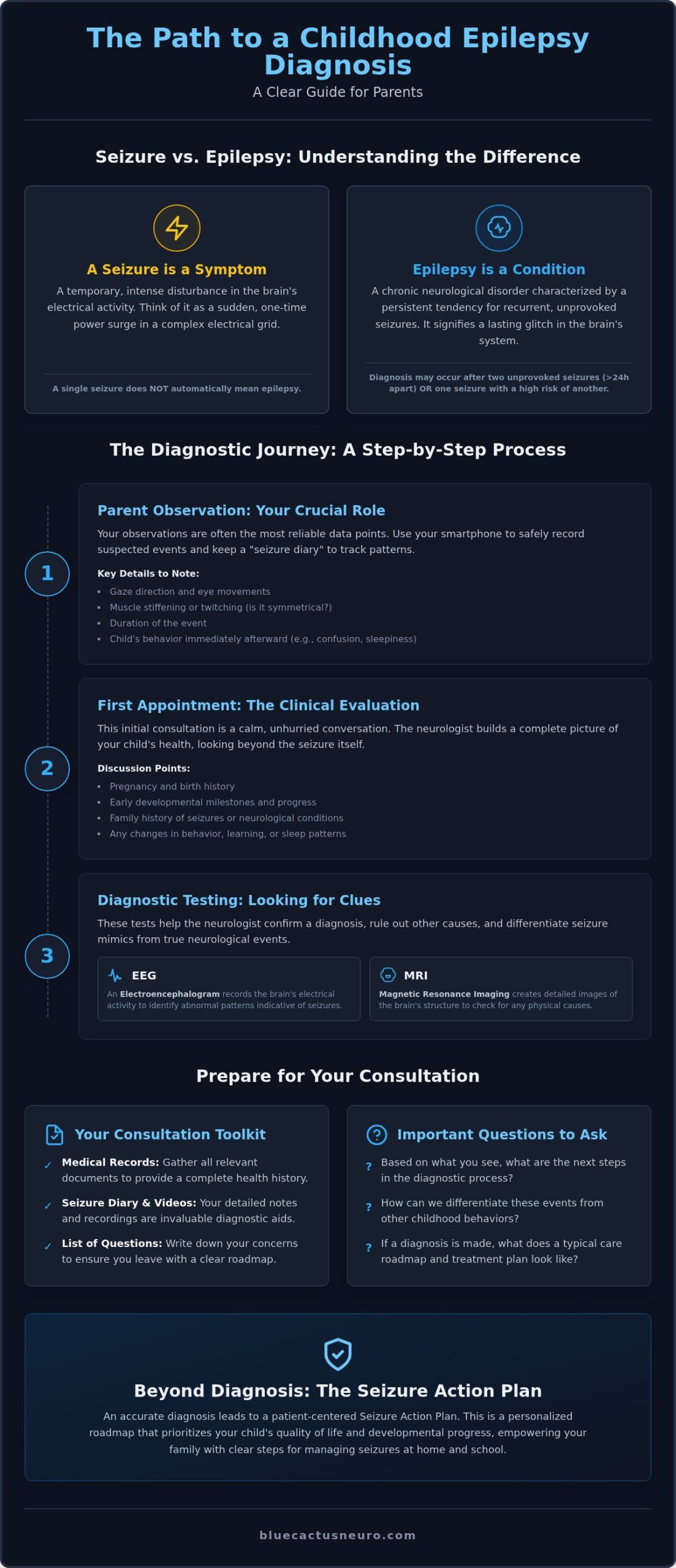
Witnessing your child have a seizure is a heart-wrenching experience. For many Arizona parents, that first event triggers a rush of questions and a deep sense of urgency. However, a single seizure doesn’t automatically mean your child has epilepsy. A childhood epilepsy diagnosis is rarely the result of a single observation or a lone test. Instead, it’s a careful, methodical process where your pediatric neurologist acts as a detective. They must rule out other potential causes, such as high fevers, metabolic imbalances, or even simple fainting spells, before confirming a chronic condition.
Traditionally, clinicians followed the “rule of two,” requiring at least two unprovoked seizures occurring more than 24 hours apart. Modern medicine has evolved. Today, if a child has one seizure but shows a high risk for another based on specific clinical markers, a diagnosis can be made sooner. This shift allows families to begin management earlier, providing a sense of control over an unpredictable situation. The emotional journey for families in Maricopa County can be taxing, but having a clear clinical roadmap helps transform fear into action.
Seizure vs. Epilepsy: What is the Difference?
It helps to think of a seizure as a symptom rather than the disease itself. A seizure is a temporary, intense disturbance in the brain’s electrical activity. It’s like a sudden power surge in a complex electrical grid. While many things can cause a one-time surge, epilepsy represents a persistent glitch in the system. For a deeper dive into these classifications, Understanding Epilepsy in Children provides a helpful overview of how these events differ across age groups. Epilepsy is a complex spectrum disorder characterized by a wide range of seizure types and varying degrees of severity that uniquely affect each child’s development.
The Importance of Early and Accurate Identification
Speed matters when it comes to brain health. An accurate childhood epilepsy diagnosis ensures that your child isn’t just treated, but treated correctly. Many childhood behaviors, such as staring spells or night terrors, can mimic seizures. A specialist’s role is to differentiate these mimics from true neurological events. Proactive evaluation is now the standard of care because it prevents secondary injuries and minimizes developmental delays. Waiting to see if another seizure happens can lead to unnecessary risks. By choosing a dedicated pediatric neurologist, you ensure your child receives an unhurried evaluation that looks at the whole picture, not just a single data point.
The Clinical Evaluation: Your Child’s First Appointment
Walking into a specialist’s office often feels like a high-stakes moment for parents. However, the first appointment is designed to be a calm, unhurried conversation rather than a series of stressful tests. The foundation of an accurate childhood epilepsy diagnosis is the medical history. Your neurologist will ask about pregnancy, birth complications, and early developmental milestones. This context helps us understand if the seizures are isolated events or part of a broader neurological pattern. We also evaluate how your child interacts with their environment, as subtle changes in behavior or learning can provide vital clues.
A thorough clinical evaluation for epilepsy requires a partnership between the physician and the family. While we use clinical tools, your observations at home are often the most reliable data points we have. We look at the “whole child,” ensuring that every concern you’ve noted is addressed with clinical rigor and empathetic care. If you are ready to begin this process, scheduling a pediatric neurological consultation in Scottsdale can help you find the clarity your family deserves.
The Power of Parent Observation
In the world of pediatric neurology, your smartphone is a powerful diagnostic tool. If you can safely record a suspected seizure, that video provides more information than a dozen written descriptions. When observing your child, try to focus on specific details. Does their gaze fix in one direction? Is the muscle stiffening symmetrical? How long does the event last, and how do they behave immediately afterward? Keeping a “seizure diary” helps track these patterns over time, allowing us to see trends that might not be obvious in a single day. These eyewitness accounts are essential for a precise childhood epilepsy diagnosis.
The Neurological Exam for Children
The physical portion of the exam is often a surprise to parents because it looks a lot like play. A skilled pediatric neurologist evaluates motor skills, reflexes, and cranial nerve function through simple activities. We might ask your child to walk on their tiptoes, follow a light with their eyes, or play with specific toys. These tasks allow us to check for:
- Muscle tone and strength: Identifying any physical asymmetries.
- Coordination and balance: Assessing the health of the cerebellum.
- Sensory responses: Ensuring the brain processes touch and sound correctly.
These gentle assessments help us identify subtle neurological signs that might point toward specific epilepsy syndromes. By making the exam feel like a game, we reduce your child’s anxiety and get a more accurate picture of their natural neurological function.
Diagnostic Testing: From EEG to Advanced Imaging
Once the initial clinical evaluation is complete, the next step in a childhood epilepsy diagnosis involves looking directly at the brain’s function and structure. These tests aren’t meant to be frightening. Instead, they serve as specialized tools that help us map your child’s unique neurological landscape. While the process might look complex, each test provides a specific piece of the puzzle, helping us move from observation to a definitive plan of care.
The EEG: Capturing the Brain’s Electrical Signature
The Electroencephalogram, or EEG, is the most common way we monitor brain activity. It’s a completely non-invasive process. We place small, gold-plated sensors on your child’s scalp using a gentle adhesive. These sensors don’t send electricity into the brain; they simply “listen” to the electrical signals the brain naturally produces. Depending on your child’s symptoms, we may recommend different types of monitoring:
- Routine EEG: A short session, usually lasting 20 to 30 minutes, to capture a snapshot of brain activity.
- Sleep-Deprived EEG: We may ask you to keep your child up late, as tiredness can sometimes trigger the electrical patterns we need to see.
- Ambulatory EEG: This involves wearing a portable device at home for 24 to 72 hours, allowing us to capture activity during normal daily routines.
It’s vital to understand that a normal EEG does not necessarily rule out epilepsy. Because seizures are intermittent, the brain’s electrical activity can appear perfectly normal between events. This is why your specialist’s clinical expertise is just as important as the data on the screen.
MRI and Specialized Imaging in Scottsdale
While the EEG looks at how the brain works, Neuroimaging (MRI) shows us how the brain is built. We use high-resolution MRI to look for structural causes of seizures, such as focal cortical dysplasia or small areas of scarring. It’s important to distinguish this from a standard CT scan often performed in an emergency room. While a CT is excellent for spotting immediate issues like bleeding, a neurological MRI provides the deep, layered detail necessary for a long-term childhood epilepsy diagnosis.
Preparing your child for an MRI is all about managing expectations. The machine is loud and requires the patient to stay very still. We often describe the sounds as “robot music” or a “space shuttle launch” to help children feel more at ease. In some cases, we may also recommend bloodwork or genetic testing. These tests help rule out metabolic disorders or identify specific genetic markers that might influence which treatments will be most effective for your child. By combining these results, we create a comprehensive view of your child’s health that goes far beyond a simple label.
Preparing for Your Consultation in the Phoenix Metro Area
Once you’ve completed the initial testing, the focus shifts to the consultation where all the data comes together. Preparing for this visit involves more than just showing up. It requires a bit of detective work on your part. If your child’s journey began with a visit to an emergency room in Mesa or a pediatrician in Gilbert, those records are vital. We need the actual imaging discs and the detailed notes from those first responders. Having these documents ready ensures that your childhood epilepsy diagnosis is based on a complete history rather than just a snapshot in time.
In the Arizona healthcare system, the referral process can sometimes feel like a maze. Most families start with their primary care provider, who then coordinates with specialists like us. We recommend checking with your insurance provider about authorizations for diagnostic tests ahead of your visit. Our Scottsdale clinic is centrally located to serve families throughout the Valley. If you’re traveling from surrounding cities, plan for traffic on the Loop 101 to ensure you arrive feeling calm and ready to discuss your child’s care.
Essential Questions for Parents to Ask
You are your child’s best advocate. During the consultation, don’t hesitate to ask for clarification on technical terms. We want you to leave with a clear understanding of the road ahead. Consider asking these specific questions:
- What type of seizures is my child having? Knowing the specific classification helps us tailor the most effective treatment plan.
- What is the long-term prognosis? Some epilepsy syndromes are outgrown during adolescence, while others require more consistent, lifelong management.
- Are there immediate lifestyle adjustments? We’ll discuss safety during common activities like swimming, sports, and sleep to keep your child safe while maintaining their quality of life.
Coordinating Care Between Specialists
A childhood epilepsy diagnosis affects every part of a child’s life. We view our practice as your “medical home” for brain health. This means we don’t just treat the patient; we coordinate with everyone involved in their well-being, including therapy specialists like those at the Autism & Brain Institute. We routinely provide documentation for schools to ensure teachers and nurses know exactly how to respond to a seizure. We also maintain open lines of communication with your child’s primary pediatrician to ensure all treatments and medications are synchronized. Navigating insurance and authorizations can be complex, but our team is here to help streamline that process for you.
Your child deserves a dedicated specialist who takes the time to listen and explain every detail. If you’re ready to take the next step in your child’s care, schedule a consultation at Blue Cactus Neurology today to begin building a personalized management plan.
Comprehensive Epilepsy Management at Blue Cactus Neurology
Receiving a childhood epilepsy diagnosis is a significant milestone, but it’s also the beginning of a proactive journey toward stability. At Blue Cactus Neurology, our approach goes beyond checking boxes on a clinical form. We focus on the “whole child,” which means we consider how neurological health impacts their school life, sports, and emotional well-being. By prioritizing unhurried appointments, we ensure every question you have is answered with patience and precision. This dedication to clarity helps families move from a state of uncertainty to a position of informed confidence.
We understand that children aren’t just small adults. Their brains are rapidly developing, and their care must reflect that reality. Families in the Phoenix metro area choose us because we provide the high-level expertise of a specialized pediatric practice without the cold, detached feel of a large institution. We are dedicated to being your partner in your child’s developmental journey, ensuring they have every opportunity to thrive despite a chronic condition. For families of younger children, this journey often includes finding supportive educational environments like Little Flowers Developmental Services, which integrates therapeutic support into a Montessori-based preschool setting.
A Patient-Centered Approach to Seizure Care
We believe that a successful management plan requires a balance of clinical rigor and empathetic warmth. Our Scottsdale practice is designed to be a modern, approachable environment where children feel safe and parents feel heard. We don’t just hand you a prescription and send you on your way. Instead, we empower your family with the knowledge needed to manage seizures confidently. This education-first model helps turn a complex childhood epilepsy diagnosis into a manageable part of your daily life. We take the time to explain the “why” behind every recommendation, ensuring you feel fully supported at every step.
A vital component of our care is the creation of a personalized Seizure Action Plan. This clear, written guide serves as a manual for your child’s caregivers, school nurses, and teachers. It details what a typical seizure looks like for your child, how to provide first aid, and when it’s necessary to call for emergency services. This plan provides peace of mind, knowing that your child is protected even when they aren’t in your direct care.
Next Steps After a Diagnosis
Once we have a clear picture of your child’s needs, we’ll discuss the full range of treatment options. This might include traditional medications, specialized dietary therapies, or specific lifestyle modifications tailored to your child’s specific epilepsy syndrome. Because children grow and develop so quickly, long-term monitoring is essential. We schedule regular follow-up visits to track progress, monitor for medication side effects, and make adjustments to the treatment plan as your child reaches new developmental milestones. Our goal is to minimize seizures while maximizing your child’s quality of life.
Your child’s brain health is too important to wait. If you’re looking for a specialist who treats your family with the respect and attention you deserve, we’re here to help. Schedule a comprehensive evaluation with our Scottsdale pediatric neurologist today.
Finding Clarity and Support for Your Child’s Journey
Securing an accurate childhood epilepsy diagnosis is the first step toward reclaiming stability for your family. This process transforms the fear of the unknown into a structured, manageable roadmap for your child’s brain health. By combining your vital parent observations with precise clinical tools like EEGs and MRIs, we can develop a care plan that prioritizes developmental progress and quality of life. You’ve learned how to prepare for your consultation and what to expect during the evaluation process, giving you the tools to be your child’s strongest advocate.
Blue Cactus Neurology, led by Board-Certified Pediatric Neurologist Ramzy Medaa, MD, provides a specialized focus on outpatient pediatric care. We are conveniently located for families in Phoenix, Mesa, and Scottsdale, offering a modern alternative to impersonal hospital systems. Our team is dedicated to providing the unhurried, empathetic attention your family deserves during this pivotal time. If you’re ready to find answers and begin a personalized management plan, we invite you to Request a Pediatric Neurology Consultation in Scottsdale today. You don’t have to navigate this path alone; we’re here to provide the clinical expertise and compassionate support your child needs to thrive.
Frequently Asked Questions
How long does a pediatric epilepsy diagnosis typically take?
The timeline for a childhood epilepsy diagnosis usually spans several weeks. It begins with an initial consultation, followed by diagnostic tests like EEGs or MRIs, which may take a few days to schedule. Once results are processed, a follow-up appointment is held to review the findings. This methodical approach ensures that every potential cause is considered before confirming a diagnosis, providing your family with the most accurate information possible.
Can a child have a normal EEG and still have epilepsy?
Yes, it’s entirely possible for a child with epilepsy to have a normal EEG result. Since seizures are intermittent events, an EEG only captures a brief snapshot of brain activity. If your child isn’t having a seizure or showing subclinical electrical discharges during the test, the reading may appear typical. This is why a pediatric neurologist relies heavily on your eyewitness accounts and medical history rather than just a single test result.
What should I do if my child has a seizure before our appointment?
First, ensure your child is in a safe environment by moving sharp objects and placing them on their side. Stay calm and time the duration of the event. If you can safely do so, record a video of the seizure on your phone. This visual evidence is incredibly valuable for our clinical evaluation. If the seizure lasts longer than five minutes or if your child has trouble breathing, seek emergency medical attention immediately.
Is an MRI always necessary for a childhood epilepsy diagnosis?
An MRI isn’t always required, but it’s a common tool used to look for structural causes in the brain. While an EEG measures electrical function, an MRI provides a detailed map of the brain’s anatomy. Your neurologist will determine if imaging is necessary based on the seizure type and the results of the initial neurological exam. For many children, imaging helps confirm that there are no underlying physical abnormalities contributing to the seizures.
How do I explain the testing process to my child without scaring them?
Use simple, non-threatening language to describe the tests as “check-ups” for their brain. You can explain the EEG sensors as “stickers” that listen to their thoughts or describe the MRI machine as a “space camera” that takes pictures of their head. Emphasize that these tests don’t hurt and that you’ll be nearby the entire time. Many clinics use child-friendly themes to make the environment feel like a playroom rather than a medical office.
What are the most common ‘mimics’ that look like seizures but aren’t?
Several common childhood behaviors can closely mimic seizures. These include breath-holding spells, fainting (syncope), night terrors, and even simple daydreaming or staring spells. Some movement disorders or tics can also be mistaken for neurological events. A specialized evaluation is necessary to distinguish these harmless behaviors from true epilepsy. By identifying these mimics early, we can often provide immediate peace of mind and avoid unnecessary treatments or medications.
Will my child’s diagnosis affect their ability to attend school in Arizona?
No, a diagnosis shouldn’t prevent your child from attending school. In Arizona, schools are equipped to support students with various health needs. We work with you to create a Seizure Action Plan that informs teachers and school nurses on how to respond if a seizure occurs. This plan ensures your child remains safe and included in all school activities. Most children with well-managed epilepsy thrive in a standard classroom environment with minimal disruptions.
Does a diagnosis of epilepsy mean my child will be on medication forever?
Not necessarily. Many childhood epilepsy syndromes are age-dependent, meaning children may naturally outgrow them as their brains mature. While medication is a common first step to achieve seizure control, it isn’t always a lifelong requirement. We continuously monitor your child’s progress and may eventually discuss tapering off medication if they remain seizure-free for a significant period. Every child’s path is unique, and our goal is always the least invasive, most effective long-term care. If your child’s first seizure occurred alongside a high fever, learning more about febrile seizures in toddlers can help you understand whether epilepsy medication is even necessary in your situation.